Free and instant — plug in your own numbers.
The interest rate is the yearly cost of borrowing the money itself, and it is the number used to calculate your monthly payment. The APR (annual percentage rate) adds most of the required upfront fees, such as an origination fee or mortgage points, and expresses the total as a yearly rate. If a loan has no fees, the two numbers are the same.
When you compare loans of the same amount and term, the APR is usually the better guide, because it puts fees and interest on one scale. The catch is that APR assumes you keep the loan for its full term. If you plan to repay early, a loan with a slightly higher APR and no fees can cost you less.
The difference at a glance
| Interest rate | APR | |
|---|---|---|
| What it measures | Cost of the borrowed money | Cost of the money plus most required fees |
| Used to set your payment? | Yes | No |
| Includes origination fees and points? | No | Yes |
| Includes late fees or prepayment penalties? | No | No |
| Best for | Working out the payment | Comparing offers side by side |
How APR is calculated: a worked example
Say you need a $12,000 personal loan over 3 years and you get two illustrative offers:
- Offer A: 10.49% interest rate, with a 6% origination fee ($720) taken out of the loan.
- Offer B: 12.49% interest rate, no fee.
Offer A looks two points cheaper. But with Offer A, you repay $12,000 while only $11,280 reaches your bank account. The APR measures the cost against the money you actually receive.
Both payments come from the standard loan formula, which is covered step by step in how to calculate a loan payment. The APR is then the rate that makes all your payments, discounted back to today, equal the cash you received:
Here M is the monthly payment, n is the number of payments and i is the monthly rate you solve for. There is no neat formula for i; lenders and calculators find it by trial and error, or with =RATE(n, −M, cash received)×12 in Excel.
| Offer A | Offer B | |
|---|---|---|
| Interest rate | 10.49% | 12.49% |
| Origination fee | $720.00 | $0.00 |
| Cash you receive | $11,280.00 | $12,000.00 |
| Monthly payment | $389.97 | $401.39 |
| Total interest | $2,039.02 | $2,449.89 |
| Interest plus fee | $2,759.02 | $2,449.89 |
| APR | 14.81% | 12.49% |
Offer A has the lower rate and the lower payment, but it costs $309.13 more once you count the fee, and its APR is more than two points higher. The APR caught what the interest rate hid.
Key idea A fee taken at the start works like extra interest squeezed into the early life of the loan. APR spreads that fee across the term so you can compare it fairly with a no-fee offer.
What APR includes and what it leaves out
In the US, the Truth in Lending Act requires lenders to disclose the APR before you sign, along with the finance charge, the amount financed and the total of payments. The Consumer Financial Protection Bureau explains these disclosures at consumerfinance.gov.
Which fees count is set by the rules, not by the lender's choice. Typically included:
- Origination, underwriting or processing fees
- Mortgage discount points and many lender charges
- Mortgage insurance, where it is required
Typically left out:
- Late fees, returned-payment fees and prepayment penalties, because you only pay them if something happens
- Some mortgage closing costs, such as appraisal and title fees
- Optional add-ons you choose to buy
So APR is a good comparison tool, but it is not the total cost of everything. Ask for the full fee list as well.
When the lower APR is not the cheaper loan
APR assumes you make every payment to the end. Fees are paid once, at the start, so the sooner you repay, the more heavily that fee weighs on what you actually paid.
Compare Offer B with a third illustrative offer on the same $12,000 over 3 years:
- Offer C: 10.49% interest rate with a 2.5% fee ($300). APR: 12.24%.
- Offer B: 12.49% interest rate, no fee. APR: 12.49%.
Offer C wins on APR. Now look at the cost if you pay off the balance early:
| You repay the loan after | Offer C cost | Offer B cost | Cheaper offer |
|---|---|---|---|
| 12 months | $1,389.44 | $1,302.12 | B by $87.32 |
| 24 months | $2,083.62 | $2,139.26 | C by $55.64 |
| 36 months (full term) | $2,339.02 | $2,449.89 | C by $110.87 |
Cost here means interest paid plus the fee. If you repay Offer C after one year, its effective rate is about 13.58%, not 12.24%. Offer B stays at 12.49% whenever you repay, because it has no fee to spread out.
The decision rule: if you might repay a loan early, give extra weight to the no-fee or lower-fee offer, even when its APR is a little higher. You can test your own repayment plan in the loan calculator.
APR on mortgages
The same effect is bigger on mortgages, because the APR spreads fees over 30 years even though many people sell or refinance well before then.
Take an illustrative $280,000, 30-year mortgage at 6.25% with $5,600 in fees and points that count toward the APR. The payment is $1,724.01 a month (principal and interest) and the APR is 6.44%. If you keep the loan for its full term, that is the true yearly cost. If you don't:
| You sell or refinance after | Effective yearly cost |
|---|---|
| 3 years | 7.00% |
| 5 years | 6.74% |
| 7 years | 6.62% |
| 10 years | 6.54% |
| 30 years | 6.44% |
This is why paying points to lower your rate only makes sense if you expect to keep the loan long enough. Our guide to whether mortgage points are worth it shows how to find the break-even month, and the mortgage calculator shows how the payment changes with the rate.
For adjustable-rate mortgages, the APR is built on assumptions about future rates, so treat it as a rough guide rather than a promise.
APR on credit cards
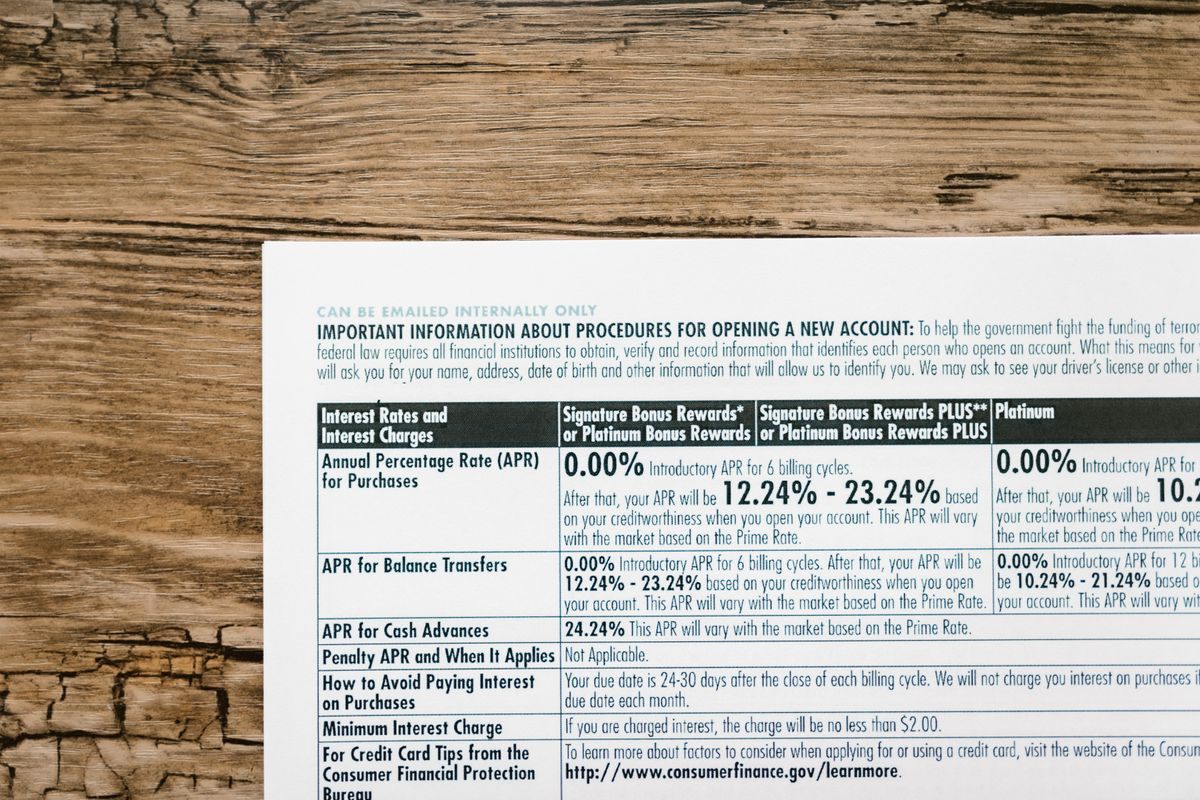
On a credit card, the APR and the interest rate are effectively the same number, because the APR is not adjusted for annual fees. What matters more is that one card often has several APRs: one for purchases, one for balance transfers, one for cash advances, and sometimes a higher penalty APR after a late payment.
Card issuers also charge interest daily, using a daily rate based on the APR. Our guide to how credit card interest is calculated works through an example.
APR is not the same as APY
APR on a loan does not include compounding. APY (annual percentage yield), used for savings accounts, does. A 12% APR charged monthly is 1% a month, which compounds to about 12.68% over a year. See APY vs APR for the full comparison.
Outside the US
- UK: Lenders show a "representative APR" in ads, and UK APRs are calculated on a compounded basis. A US-style APR of 12.49% works out to about 13.23% on the UK basis, so compare offers from the same country.
- Australia: Lenders show a "comparison rate" next to the advertised rate, which plays the same role as APR by folding in most fees.
- Canada: Lenders disclose the APR and the total cost of borrowing before you sign.
Frequently asked questions
Why is my APR higher than my interest rate?
Because the loan has fees that count toward the APR, such as an origination fee or points. If there are no such fees, the APR and the interest rate are equal.
Can the APR be lower than the interest rate?
It can, if the lender covers some of your costs with lender credits that outweigh the fees. On a standard loan with fees and no credits, the APR will be higher than the rate.
Is my monthly payment based on the APR?
No. Your payment is calculated from the interest rate and the loan amount. The APR is a disclosure figure for comparing total cost.
Should I always choose the lowest APR?
Usually, if you will keep the loan for the full term and the offers have the same amount and length. If you may repay early, or the terms differ, compare the actual dollar cost over the time you expect to hold the loan.
How to decide
- Ask every lender for the interest rate, the APR and a full list of fees, using the same loan amount and term.
- Check whether fees are added to the loan or taken out of the cash you receive.
- Compare APRs only between loans of the same term; a longer loan can show a lower APR and still cost far more in total.
- Estimate how long you will really keep the loan. If it is much shorter than the term, favor lower fees.
- Run each offer through the loan calculator and compare the total you would pay in dollars, not just the percentages.
This article is for general education and is not financial advice. Rules, rates and products vary by lender and country. See our disclaimer.